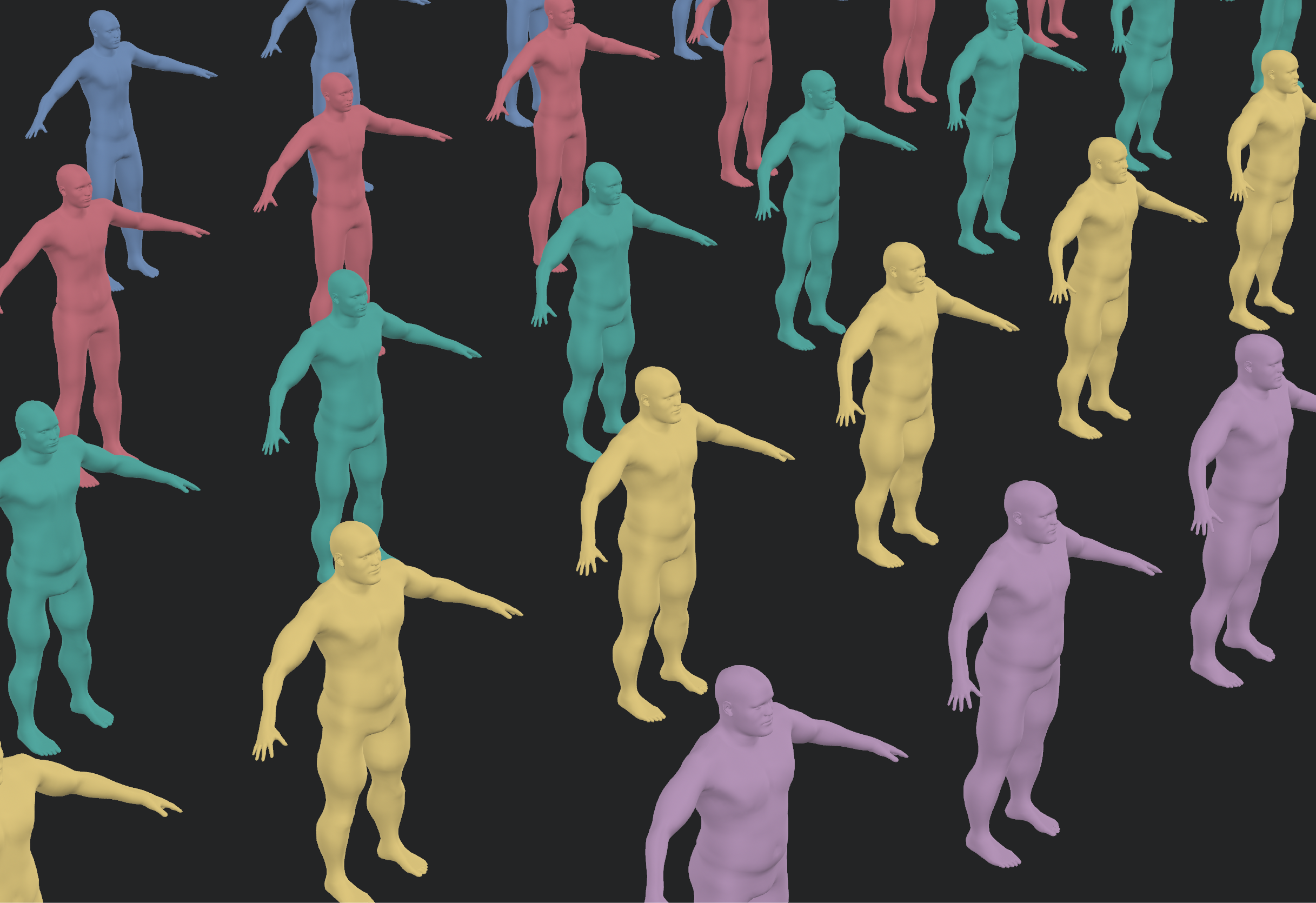
Body distribution (apparel sizing): a population of body shapes that statistically represents a target customer demographic, used to test how a graded pattern fits across the natural variance within each size — rather than on a single representative mannequin.
Bodies are not points.
They are distributions.
Most apparel fit work starts from a representative body, a single mannequin shape per demographic refined over decades of industry practice. It's the foundation of how patterns are designed and graded. It's also the source of edge-case fit failures that show up in returns, in fit-session surprises, and in extended sizes that don't behave like base sizes.
Nabla Labs extends body standards with body distributions. Within the demographic your standard represents, we sample dozens of body shapes that reflect the actual variance of real customers. Your patterns are stress-tested across those bodies before production, surfacing the grading inconsistencies that single‑mannequin methodology cannot expose.
What is a body distribution?
A body standard answers: 'what body should we design for?' A body distribution answers: 'what range of bodies will actually wear this size?' The first is a target. The second is the reality.
Calibrate the distribution against public anthropometric datasets (UK, US, EU, Nordic, Asia-Pacific surveys).
Tune the distribution against your existing size charts or brand fit standard, so it inherits your brand identity.
Sample and visualise the population, then run your patterns across it.
This is the body distribution: not a single mannequin, but a calibrated population of bodies that reflects who actually wears your product.
How this changes the conversation
From "the size set fit our model" to "the size set fits the population."
Moving beyond single-point validation to ensure your garments work across the natural variance within each size bracket.
From edge-size guesswork to edge-size validation.
Stop hoping standard grade rules hold up at the extremes. See exactly how extended sizes behave before cutting fabric.
From inclusive marketing to inclusive fit.
Extended-sizing commitments require grading rigour. We provide the population‑aware foundation to back up your sizing promises.
Where the distribution comes from
We use an internal body‑shape model that produces realistic 3D bodies parameterised by anthropometric inputs. The model is trained on and calibrated against public body-scan datasets including ANSUR (US Army), CAESAR (international civilian populations), and national surveys (Size UK, Size USA, Size NL, and others). Brands can extend the calibration with their own measurement data or fit standards, so the population reflects their actual market, not a generic average.
We deliberately keep the body model decoupled from any specific scanner technology, fit standard, or CAD platform. Bodies generated this way are portable: they can be used as test bodies for your existing 3D tools, exported to standard formats, or kept entirely inside our analysis pipeline.
Why this is hard, and why it isn't done elsewhere
Generating realistic 3D bodies that interpolate smoothly across a population and respond correctly to anthropometric inputs is a research-grade problem. Most fit infrastructure today operates on discrete mannequins because the discrete approach was, for many years, the only one that worked. Building reliable body distributions is recent capability, and it is not yet part of standard fit-tech tooling. We made it part of ours.
Outcomes
The Population Advantage
Test your patterns on the body distribution that matches your real customer base, not a single representative mannequin.
See per-size, per-population fit risk before production.
Identify fragile sizes (edge sizes, extended sizes, inclusive sizing) that single‑mannequin grading misses.
Calibrate the distribution to your specific customer demographic instead of a generic average.
Combine with our pattern‑correction engine to close the loop: detect, then correct.
Ready to see your population?
Talk to us about running a population‑aware fit analysis on your most challenging size ranges.
Request a population fit demo